


The year 2025 will be marked on the international calendar as the Year of Quantum Science and Technology, marking one hundred years since the foundational work of quantum mechanics began in 1925 with the contributions of Werner Heisenberg. A century later, quantum mechanics is once again at the center of the debate, not only as a fundamental theory of physics, but also as a technology with the capacity to transform the economy and industry.
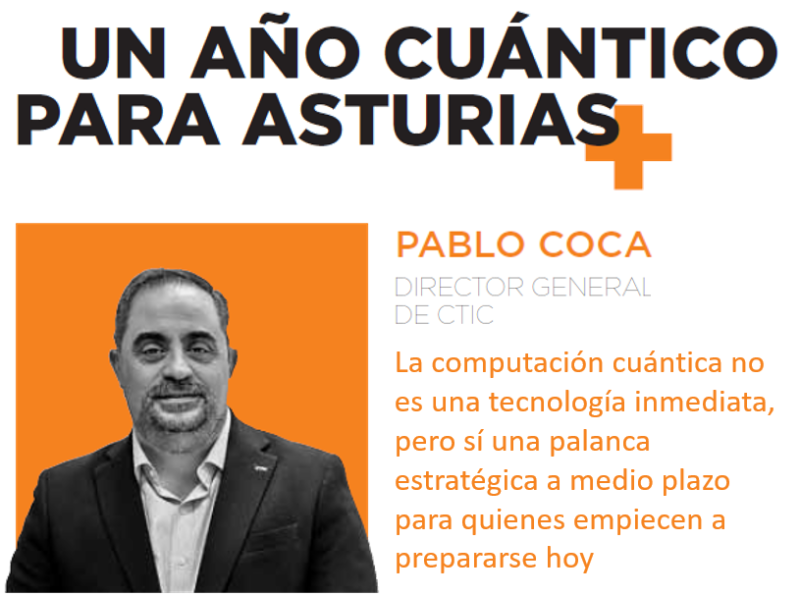
Within the group of quantum technologies, quantum computing represents a new way of processing information. While traditional computing is based on bits that can only take the values 0 or 1, quantum computing uses qubits, capable of representing multiple states at once thanks to physical phenomena such as superposition and entanglement. This allows this new type of computer to approach problems in a radically different way, and therein lies its disruptive promise. Quantum computing can bring benefits in very specific areas such as the optimization of complex logistical routes, the management of energy networks, the simulation of molecules and materials, the improvement of advanced artificial intelligence models or the reinforcement of cybersecurity. It is not an immediate technology, but it is a strategic lever in the medium term for those who start preparing today.
In Asturias we are far from being oblivious to this technological revolution. Back in 2006 we recognized the relevance of this field by awarding the Prince of Asturias Award for Technical and Scientific Research to Juan Ignacio Cirac, one of the world's leading figures in quantum computing. And 2025 was not just an ephemeris. It was the year in which a reality that had been under construction for some time became visible. The Spanish Quantum Technologies Strategy, published in April of this year, identifies us as one of the few territories in Spain where quantum poles are being developed and growing, along with Catalonia, the Basque Country, Galicia and Madrid.
The positioning we have gained as a region is supported by an ecosystem built around three pillars, complementary and aligned with two of the main lines of work of the Spanish Quantum Technologies Strategy: the generation of capabilities, both material and human, and the awareness of companies and society about the real benefits of the technology.
The first pillar is the academic one. The University of Oviedo, through the Quantum and High Performance Computing (QHPC) research group, and the Center for Research in Nanomaterials and Nanotechnology (CINN), a research center located in El Entrego, form a solid scientific base. The QHPC group develops reference research in quantum algorithms, high performance computing and advanced artificial intelligence models supported by quantum computing, in collaboration with international reference institutions such as CERN. In addition to these capabilities, there is a particularly differential element: the development at the CINN of a quantum computer based on Rydberg atoms, which will become the first of its kind manufactured in Spain, placing us among the few European territories with their own capabilities in this field. This unique infrastructure connects directly with one of the priorities of the Strategy, that of having our own material capabilities, strategic at national and European level.
The generation of human capabilities completes this academic pillar. A university micro-credential in quantum computing has been designed and launched in 2025, which will be launched in 2026 through the CTIC Chair of Digital Transformation of the University of Oviedo. This is an initiative aimed at training professionals with an applied vision, connecting training, research and real needs of the productive fabric.
The second pillar is that of transfer, and here the role of CTIC Technology Center is proving to be decisive. Since 2019, CTIC is committed to applied quantum computing with a very clear idea aligned with the Spanish Strategy: there is no awareness without demonstration. Seeing is believing.
In this line, the efforts of the technology center have focused on developing demonstrators and real use cases that allow companies and institutions to understand what problems it makes sense to address with quantum computing. To this end, CTIC has a specialized team as well as the unique QUTE infrastructure, capable of emulating a quantum computer of 38 logical qubits, being today the equipment with the highest emulation capacity at national level and one of the most powerful at European level.
This approach was recognized in 2023 with the accreditation of CTIC as a Cervera Technology Center of Excellence in Quantum Technologies by the Center for Technological Development and Innovation (CDTI). Through the coordination of the ARQA Network, in which other technology centers in Catalonia and Galicia participate, use cases related to Earth observation using satellite images, optimization of photovoltaic energy production in local energy communities or fraud detection in digital signatures generated by artificial intelligence were developed. In 2025 the CDTI has once again placed its trust in CTIC with the approval of the ARQADE Network, an evolution of ARQA, incorporating new partners from the Valencian Community and Castilla y León, and orienting the Network to the development of demonstrators in defense scenarios, such as optimizing the deployment of drone swarms, advanced analysis of satellite images or the guidance of autonomous vehicles in environments with access denial to GPS services.
The third pillar is the company, an essential element for quantum to stop being a promise and become an impact. We have technology companies that have been developing R&D projects in quantum computing for years, as is the case of Izertis, and companies such as Seresco and Satec, which are evaluating the impact of quantum in areas such as cryptography and cybersecurity. Added to this is a solid industrial base, with companies such as ArcelorMittal, which are already exploring these technologies to solve complex optimization problems in their production processes.
In this context, the Asturias ICT Cluster has positioned itself as a driving force, promoting the development of use cases that allow progress in this progressive awareness that marks the Strategy. It is worth highlighting the incorporation of the Cluster itself to one of the national consortiums funded by Red.es for the development of use cases in quantum computing, with the collaboration of CTIC Technology Center, in areas such as the detection of cyber-attacks in systems with IoT devices or last mile logistics optimization.
It should be noted that the size of our region gives us a rare competitive advantage, such as the proximity between actors. Academia, transfer and business collaborate directly, which accelerates experimentation and reduces the distance between research and its real application. Added to this is the interest of the Directorate General for Digital Strategy and Artificial Intelligence of the Principality of Asturias in promoting this emerging quantum ecosystem.
For all these reasons, 2025 has been a quantum year for Asturias. The challenge now is to scale, attract investment, retain talent and continue to strengthen these three pillars.
Quantum computing is not a distant promise, it is a reality under construction. And we are on time and we have the means to take advantage of it.