


Origin of the initiative
TENCLAVE was born within the framework of the European TrustChain project, promoted by the Next Generation Internet program, a European Union initiative to promote a more secure, transparent and privacy-friendly internet.
TrustChain has supported 75 European organizations and startups working on digital solutions based on a more decentralized, open and ethical internet model, using innovative technologies such as blockchain. Through five public calls, the program has allocated €8.8 million to fund projects that improve the way we share and manage data in Europe, always aligned with EU regulations and with high standards of protection.
Among the selected entities is CTIC Centro Tecnológico, which launched the TENCLAVE project in mid-2025. The initiative ends this February and has been recognized as one of the most outstanding projects of the program, participating in the final TrustChain event held on February 5 in Ljubljana (Slovenia).
What is TENCLAVE?
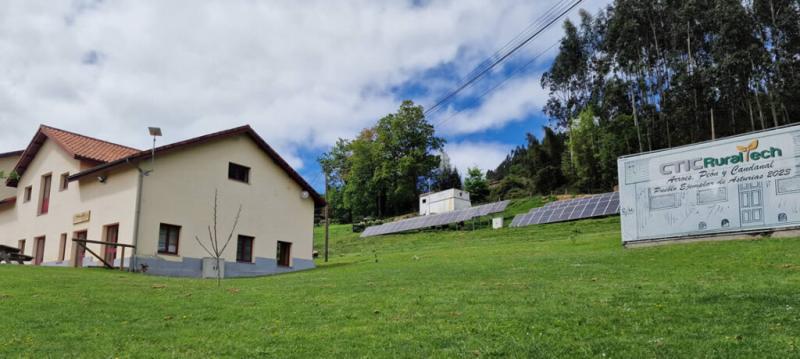
TENCLAVE is a pioneering system developed by CTIC to help rural energy communities, such as those of Peón and Arroes, to manage their electricity more efficiently and intelligently.
In simple terms, it allows neighbors sharing solar installations and community batteries to make better use of the energy they generate, reduce costs and optimize consumption... without anyone having to reveal private data about their household electricity use.
How does it work?
The system analyzes the community's energy consumption data using advanced cryptographic technologies that allow working with this information without it being visible or accessible to third parties.
The platform can calculate when it is convenient to store energy in the batteries, decide the best time to use it and can distribute it among neighbors looking for the greatest collective savings without knowing the individual consumption habits of each household.
In conclusion, TENCLAVE coordinates the use of solar panels and community batteries so that energy is consumed at the most efficient times, maximizing the benefit for all.
What does it bring to the communities?
Through this system it has been possible to improve energy efficiency, using energy at the most appropriate time and reducing the electricity bill of the neighbors, thanks to an intelligent and coordinated management.
All this, guaranteeing the privacy of the data and the information of consumption and uses of the neighbors. The system is designed so that personal data is not exposed, even when used for collective calculations.
Thanks to this intelligent and secure management, a family can reduce its daily energy expenditure automatically, also contributing to a cleaner and closer energy model. How much can be reduced, percentage-wise, the expenditure? We have calculated that 16% of the cost can be reduced during peak hours and 5% throughout the day thanks to the intelligent use of batteries. We discharge them only when they are most needed. On the other hand, people can save by adapting to what the energy community is producing at any given time.
Although TENCLAVE has been developed specifically for the energy efficiency sector, the technology it employs can be applied in other areas where sensitive data needs to be analyzed without compromising confidentiality. In that sense, it is part of a broader European ecosystem that seeks to build trusted digital solutions aligned with European values. As an immediate result, CTIC is already using the technology developed as a demonstrator and platform on which to develop applications in other areas.
The Technologies.
Operations with encrypted data (FHE)
One of the key pieces is the use of FHE technology, which allows mathematical operations to be performed directly on encrypted numbers. This means that the system can calculate how much energy the community needs or when to drop a battery charge without the need to 'decrypt' or see the actual consumption data of each neighbor, keeping the information protected under electronic lock and key at all times. The entire process of key management and use is managed directly in blockchain, making it have the highest security standards.
It is a fairly recent technology with enormous potential for the field of data security and privacy, and it is the first time it has been applied to the energy field in a decentralized way.
Demonstrations Without Revealing Data (ZKP)
It also uses so-called Zero Knowledge Proofs (ZKP), a technique that allows something to be proven to be true without revealing the data that proves it. In practice, this allows a neighbor to demonstrate that they have met an energy saving target to receive a reward, but without having to show private details about what appliances they use or what times they are at home. This has an immediate application for promoting private-to-private energy sharing models.
Blockchain and digital rewards (Tokens)
To make everything transparent, the system uses Blockchain technology, which functions as a virtually impossible-to-manipulate digital ledger where all transactions are recorded. Through this register, neighbors who adjust their consumption to sunshine hours receive tokens or digital points as a reward, which can be redeemed for direct discounts on the electricity bill or for benefits within their own energy community. The tokens are managed within a closed circuit that does not allow trading with external entities, reducing the chances of fraud.